SAIL / Surf Life Saving NSW × ResQVision
Built with
lifesaving teams.
Tested on the coast.
Coastal cameras. AI event detection. Human decisions.
Working with Surf Life Saving NSW to flag potential water-entry events for operator review.

- Programme with Surf Life Saving NSW
- SAIL · Surveillance AI
for Lifesaving - Public trial sites
- Kiama Blowhole
and Little Bay - Receiving team
- SLSNSW State
Operations Centre - Published trial period
- 14 months, ending
November 2026
Current status, November 2026: The SAIL trial has been extended. ResQVision is exploring potential additional sites for 2027.
The operating environment
Monitoring exposed rock platforms
At an exposed rock platform, a person can enter the water suddenly and beyond a patrol’s immediate sightline.
The camera view needs to include the hazard area and adjacent water so an operator can check what happened. Camera position and coverage are part of the safety assessment.
Glare, swell, spray, distance and obstruction change the scene. Power, connectivity and nearby rescue resources also shape whether a site is ready for this kind of monitoring.
SLSNSW’s programme overview
The partnership
Our work with SLSNSW
SLSNSW brings local hazard knowledge and response procedures. Together, we shape the camera setup, test alerts and improve how the system supports operators.
Local knowledge and response
SLSNSW brings knowledge of the site, its hazards and risks, and State Operations Centre (SOC) procedures. Its operators review alerts and coordinate any response through established communications.
Camera setup, operation and testing are collaborative, with ResQVision providing technical support.
Trained responders carry out any rescue.

Software and deployment support
ResQVision develops the detection and tracking software and works with SLSNSW on camera hardware and operation, on-site server setup, field testing and alert delivery.
Footage review and operator feedback guide further development and testing.
For another organisation, we agree camera, network and support roles together to suit the site and the team.
Software and models
Developing detection modules with diverse datasets, local footage and simulated events.
Development draws on datasets from locations around the world, across different times of day and weather conditions. Local footage and simulated fall and water-entry events at the platforms help refine models for glare, salt on the camera lens, distance and changing coastal conditions.
Software modules
- SAIL building block
Person detection
People and movement in the camera view.
- SAIL focus
Fall detection
Potential falls and water entry for operator review.
- Wider analytics
Vessel detection
Vessels and their movement in the scene.
- Wider analytics
Current & flow detection
Water-movement patterns for separate evaluation.
SAIL focuses on people and potential falls or water entry. Vessel and current/flow analytics require their own scope and site testing.
Cameras and Axis hardware
Camera requirements, Axis hardware support and coordination with suppliers and SLSNSW.
Framing, power and connectivity determine whether the event is visible and the feed is usable.
Server and processing
Setting up on-site processing and getting alerts to the State Operations Centre.
We test the path from the camera feed to the receiving operator, so the team can review the scene and decide what to do next.
Field work and data
Collecting footage and testing camera coverage and alert views together.
Field testing with SLSNSW personnel checks what the camera can see and what an operator sees when an alert arrives. It helps identify gaps, obstructions and difficult conditions.
Operator experience
Working alongside operations-centre teams and improving alerts through their feedback.
Once alerts start arriving, operator feedback helps us refine the information and views presented alongside existing calls and camera feeds.
Ongoing care
Technical assistance through patrol operations and when out-of-hours support is needed.
We work with the team on system checks, camera and feed issues, and maintenance. Support coverage, escalation and on-site assistance are agreed for each deployment.
How it works
From camera to response
From camera observation to operator review and response coordination.
- 01
The rock platform and water
Camera observation
Cameras show the agreed rock platform and adjacent water. Glare, distance and obstruction affect what can be seen.
- 02
Potential water entry
Event detection
The software analyses the camera feed for potential unexpected water entry and raises an alert for operator review.
- 03
Operator judgement
Human review
An SLSNSW State Operations Centre operator reviews the alert and checks the scene to assess what happened and whether a response is needed.
- 04
Existing response procedures
Response coordination
When a response is needed, the operating team uses established communications and procedures to coordinate the appropriate resource.
An alert prompts a check. Operators assess the situation and coordinate any response; trained teams carry it out.
Field experience
What field testing taught us
Field work, footage review and operator experience inform what we build and what we test next.

Camera coverage
The rock edge, waterline and area a person can move through need to be visible together. Camera position affects whether an operator can see the complete event.
What this means operationally
Review the complete hazard area and adjacent water when assessing camera coverage.
Glare and lens condition
The recorded SAIL footage shows glare, lens marks and distant people. Test footage needs to represent these everyday coastal conditions.
What this means operationally
Review false alerts and missed events across representative conditions.
Alerts in the operator workflow
Time alongside the State Operations Centre team helps us understand how an alert sits alongside calls, camera views and existing response procedures.
What this means operationally
Assess how operators receive, check and acknowledge an alert, and how much review effort it adds.
Evidence
What the evidence shows
Public accounts describe how camera analysis, operator review and trained responders form part of the same response process.
Reported operational responses
The AFAC26 paper describes a jet-ski recovery in Sydney’s eastern suburbs and a helicopter response at Kiama. The accounts recognise the role of lifejackets and trained responders.
- Trial sites at Kiama Blowhole and Little Bay.
- Alerts reviewed by SLSNSW operators.
- On-site setup, field testing and technical assistance.
- Public programme and conference accounts.
Limits and site testing
Camera coverage, obstruction, weather, power, connectivity and available rescue resources affect what a site can support.
Evaluate missed events, false alerts, operator review effort and the steps from alert to response in representative conditions. The absence of an alert does not prove that no incident occurred.
New detection or analytics need their own testing. Public incident accounts do not establish a general accuracy rate or attribute a rescue to software alone.
Read the source record and trial status
SLSNSW’s public page, checked 29 October 2026, describes a 14-month trial ending in November 2026. The trial has since been extended; see the current status above. No accuracy, uptime, quantified time saving or software-attributed rescue total is claimed on this page.
- Surf Life Saving NSW programme overviewTrial sites, purpose, operating workflow and published trial period.
- AFAC26 resource and conference paperPublic operational account, evaluation approach and conference contributors.
ResQVision’s delivery account also records server setup, field testing and time observing the SOC. The companion report includes source references.
Your site
Plan a trial at your site
An initial discussion can define the camera coverage, event to detect, operator review process, responsibilities and measures of success for a first-site evaluation.
The view
Camera framing, image quality, coverage, movement, power and connectivity.
The event
Define the event to detect and compare alerts with independently reviewed footage showing what actually happened.
The team
Who receives and checks alerts, decides on a response, and maintains the cameras and connections.
The evidence
Missed events, false alerts, operator review effort and the steps from alert to response.
Before an evaluation, agree data permissions, camera and network responsibilities, technical support, and what evidence will count as success.
How we assess a camera view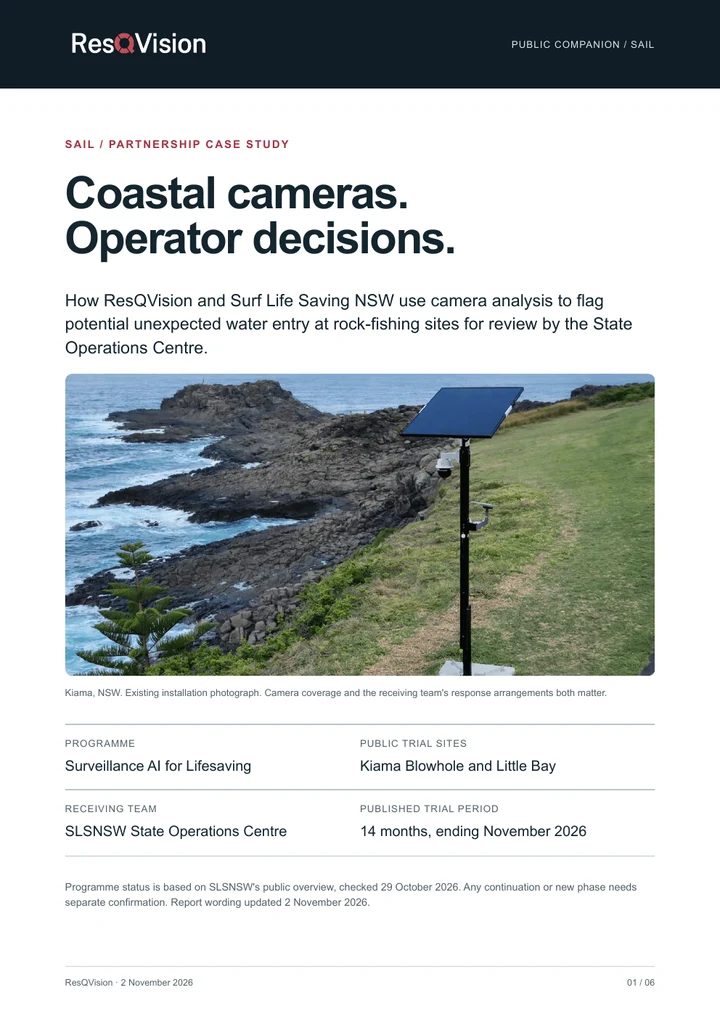
Public companion
SAIL partnership report
The partnership, operating workflow and lessons, with references for a deeper read.
The public companion is available directly. No form is required.
PDF · 6 pages · 2 November 2026
Work with ResQVision
Talk us through your site and the information your operators need. If you already have cameras, a representative view is a useful starting point.
Discuss your site