
For teams responsible for monitored rock platforms
Water-entry monitoringfor rock platforms.
Unexpected water entry can happen in seconds. Start with the monitored rock platform, the camera view and the team that needs the evidence to verify an event.
Free camera assessment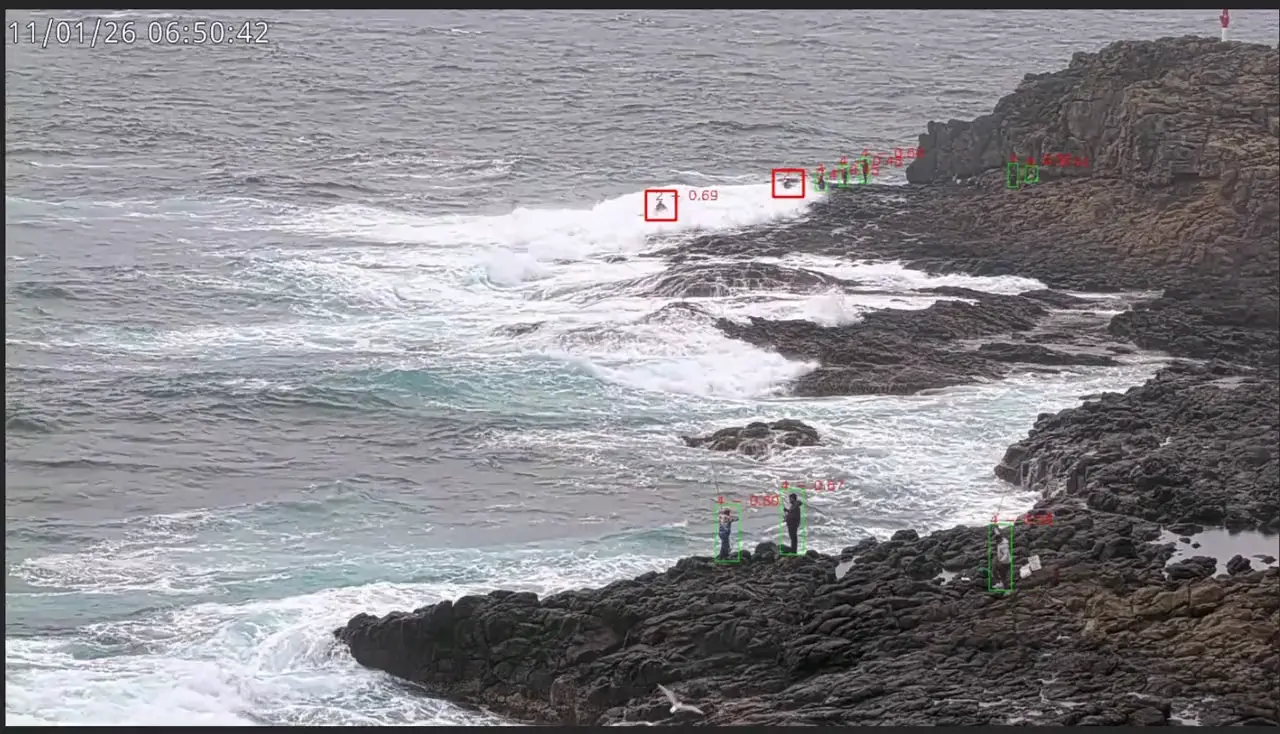
How it helps your team
Bring a potential water-entry event into view.
Define the event
Monitor the transition from the platform into adjacent water, with a camera view suited to that task.
Check the complete scene
Give operators the footage and timing needed to distinguish a potential event from waves, spray or ordinary movement.
Connect the receiving team
Agree who reviews alerts and how verified observations enter the site’s response pathway.
Field delivery
The SAIL operating context.
Rock-platform water entry is the initial event focus in Surf Life Saving NSW’s publicly documented SAIL programme. ResQVision’s contribution combines AI software, alert integration, on-premises setup, field testing and support.
The sourced case describes the contribution, sites and published incidents. Those accounts do not establish platform-wide detection or rescue performance.
Read the SAIL case studyAI software
Analysis of suitable camera footage for people, movement and configured water-entry events.
Alert integration
Connecting detections with the operating team’s alerting arrangements.
On-premises setup
Setup for local operation within the agreed deployment.
Field testing and support
Testing and refinement with the Surf Life Saving NSW operating team.
From event to review
Define the water entry.Keep the evidence.
For an evaluation, define a person moving unexpectedly from the monitored platform into adjacent water. The event label must distinguish that transition from waves, spray and ordinary movement around the scene.
Supporting records and operator review
- The event
- Unexpected movement from the platform into adjacent water.
- The view
- Enough detail to follow the person across the platform edge.
- The evidence
- Footage and timing that let an operator verify what happened.
- The response pathway
- The receiving team and its established communications and response arrangements.
Lifejackets, signage, public education and capable responders remain part of the safety setting.

Camera placement and conditions
Camera placement and conditions
The camera needs to show the platform edge and nearby water. Swell, reflections, occlusion and the shape of the rock can hide the transition. Assess ordinary and difficult conditions, and whether another viewpoint is needed.
Camera compatibilitySite assessment
Evaluate one camera view.
Identify the platform, the view and the event your team needs to notice. Confirm who reviews alerts and which response resources are available before a larger pilot is agreed.
What we assess
Site and camera view
Your location, camera view and coverage.
Event of interest
The event your team needs to notice.
Representative conditions
Typical weather, light and sea conditions.
Receiving team
Who reviews alerts and how they respond.
What you receive
A written recommendation
For one camera view, outlining suitability and considerations.
Proposed next scope
Where relevant, agree suitable inputs, output requirements and evaluation criteria.